
If you’ve ever stood in the aisle staring at bags of concrete on one side and a couple of lightweight foam kits on the other, you’re not alone. I’ve used both—and this is one of those decisions where “easy” and “better long-term” are not always the same thing.
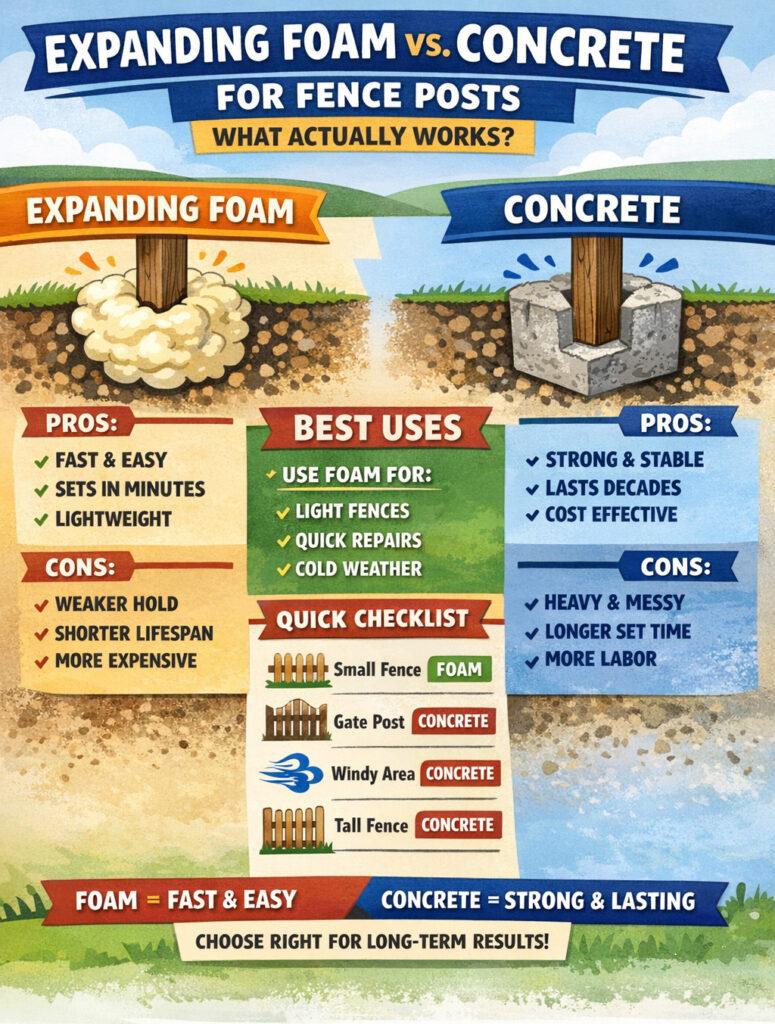
Let’s break it down the way you’d actually decide on your own property—based on soil, fence type, and how much effort you want to put in today vs. how much you want to avoid fixing later.
Quick Take (If You Don’t Want to Read Everything)
- Use concrete for: wood fences, gates, windy areas, long-term installs
- Use foam for: light-duty fences, quick repairs, cold-weather installs
If you’re on the fence (no pun intended), concrete is still the safer bet.
What You’re Really Choosing Between
Concrete (The Traditional Workhorse)
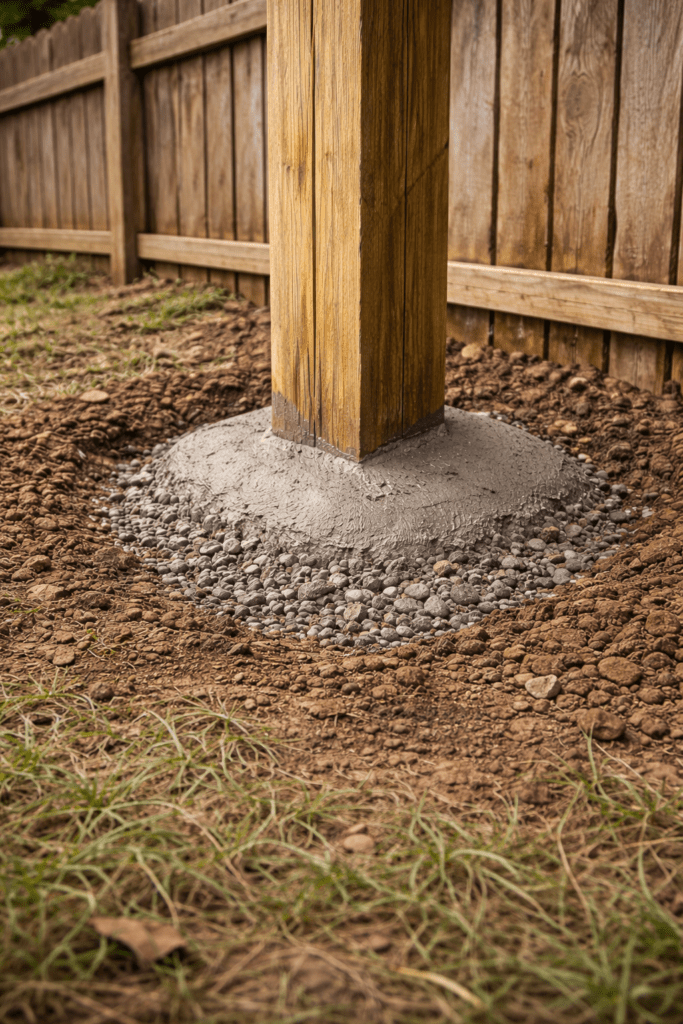
Concrete has been the go-to for decades because it’s heavy, dense, and structurally reliable. Properly installed, it can last 50+ years.
Expanding Foam (The New Shortcut)
Foam is a polyurethane product that expands to fill the hole and locks the post in place. It sets in minutes and is incredibly easy to use—but it trades strength for convenience.
Side-by-Side Comparison
1. Strength & Stability
- Concrete:
- Best for load-bearing posts (gates, tall fences)
- Heavy mass resists wind and shifting
- Foam:
- Good for light-duty fences
- Less rigid and not ideal for structural loads
👉 Real-world takeaway: If your fence will catch wind or support a gate, foam is a gamble.
2. Installation Speed
- Concrete:
- Initial set: ~30–60 minutes
- Full cure: up to several days
- Foam:
- Sets in minutes
- Fully cured in ~15 minutes
👉 If you want to install posts and be done the same day, foam wins easily.
3. Ease of Use
- Concrete:
- Heavy (80 lb bags)
- Requires mixing or watering in place
- Foam:
- Lightweight
- No mixing, just pour
👉 Foam is dramatically easier on your body—especially for multiple posts.
4. Cost
- Concrete:
- About $8–$10 per bag
- Typically cheaper overall
- Foam:
- 25% to 3× more expensive
👉 Foam saves labor, but not money.
5. Durability Over Time
- Concrete:
- Long lifespan (50+ years possible)
- Can crack from freeze/thaw cycles
- Foam:
- Lasts ~15–40 years
- Doesn’t absorb water
👉 Concrete wins on lifespan—but drainage matters more than material.
Where Each One Actually Makes Sense
Use Concrete If:
- You’re installing a wood privacy fence
- You have a gate or corner posts
- Your area gets wind or soft soil
- You want a set-it-and-forget-it solution
Use Expanding Foam If:
- You’re installing lightweight fencing (wire, vinyl panels)
- You want speed and minimal effort
- You’re working in cold weather
- You’re doing a temporary or small project
👉 Example: Garden fence or quick repair where convenience matters more than longevity.
The Real Trade-Off Nobody Talks About
Here’s the honest part:
- Foam is appealing because it’s easy
- Concrete is annoying—but reliable
And when posts fail, it’s almost never immediately. It’s:
- 6 months later
- after a storm
- when a gate starts sagging
That’s when the “easy” choice comes back to cost you time.

Printable Checklist: Choosing Foam vs Concrete
Use this before you install:
✔ Fence height over 5 ft → Concrete
✔ Gate attached to post → Concrete
✔ Wind exposure → Concrete
✔ Soft or sandy soil → Concrete
✔ Cold weather install → Foam OK
✔ Small/light fence → Foam OK
✔ Need same-day install → Foam OK
Time to Complete (Realistic Expectations)
| Method | Time Per Post | Full Project Time |
|---|---|---|
| Foam | 10–15 minutes | Same day |
| Concrete | 30–60 minutes | 1–2 days |
👉 Foam feels faster—but concrete is not as slow as people think, especially with dry-pour methods.
Recommended Approach (What I Actually Do)
For most homeowners, the best hybrid strategy is:
- Concrete for:
- Gate posts
- Corner posts
- Foam or tamped gravel for:
- Intermediate posts (optional)
This gives you strength where it matters and saves effort elsewhere.
Resources
For deeper guidance, these will help:
- How to Repair a Fence Post Without Replacing It
- Complete Guide to Fixing a Fence
- Concrete VS No-Concrete Fence Post Repair
Frequently Asked Questions
Is expanding foam strong enough for fence posts?
It can hold light-duty posts, but it’s not recommended for load-bearing or high-wind situations.
Does concrete rot fence posts?
It can trap moisture if installed incorrectly. Adding gravel at the base improves drainage.
Can I mix foam and concrete?
Yes—many people use concrete for critical posts and foam for the rest.
What’s the biggest mistake people make?
Choosing foam for gate posts. That’s where failures show up first.
Is concrete overkill for small fences?
Sometimes—but it’s still the safest long-term option.
Conclusion
If you’re trying to decide between expanding foam and concrete, the real question isn’t “Which is easier?”—it’s: “Do I want to do this once, or twice?”
Foam is fast, clean, and surprisingly effective for the right situations. But concrete still wins where it matters most—strength, stability, and long-term reliability.
If your fence has any weight, wind exposure, or a gate involved, don’t overthink it—go with concrete and move on.
Resources
- Angi – Fence installation material comparisons
Expanding Foam vs Concrete Fence Posts (Angi)
Covers cost, durability, and when to use each material for fence posts.
- Bob Vila – DIY fence post guidance
Expanding Foam vs. Concrete Fence Post Guide (Bob Vila)
Breaks down installation methods, curing time, and real-world pros/cons.
- InterNACHI – Structural and moisture insights
Moisture and Wood Decay Guidance (InterNACHI)
Explains how moisture, drainage, and installation affect fence post longevity.